Best Alternative to Shopify POS for Every Business Type
The best Shopify POS alternative for retailers who want to keep Shopify online is PHP Point of Sale: unlimited registers per location from $54.00 per month on annual billing, plus official Shopify inventory sync. Shopify POS still fits brands that want one vendor for web and store, but many retailers switch when POS Pro pricing and shallow inventory become the constraint.
PHP Point of Sale is a practical Shopify POS alternative if you want to keep your Shopify storefront and run in-store checkout on a dedicated retail POS. Cloud Standard plans start at $54.00 per month per location billed annually, or $59.00 per month per location billed monthly. The Shopify add-on syncs inventory and imports orders for $29.00/mo (billed through Shopify, with a 14-day trial). See the full PHP POS vs Shopify comparison, explore features, or start a 14-day free trial. Prices shown are for the United States; see the pricing page for your country.
Why consider a Shopify POS alternative?
Shopify POS is not always the cheapest or deepest option once you add locations, Pro features, and processing. Store owners typically shop alternatives when software cost per register climbs, inventory tools feel limited, or they want a retail-first POS without leaving Shopify online.
Common reasons store owners look beyond Shopify POS:
- POS Pro is often cited around $89 per month per location on top of your Shopify plan (third-party 2026 guides; confirm on Shopify).
- You may only need stronger register workflows, not a full platform swap.
- Multi-location retailers sometimes want deeper inventory matrices than basic POS tiers offer.
- Restaurants and service businesses often need industry-specific tools Shopify POS handles through apps, not natively.
- Payment processing and hardware lock-in can raise total cost at higher volume.
You do not have to leave Shopify online to change your in-store POS. That is where integrated alternatives matter most.
What are the top Shopify POS alternatives?
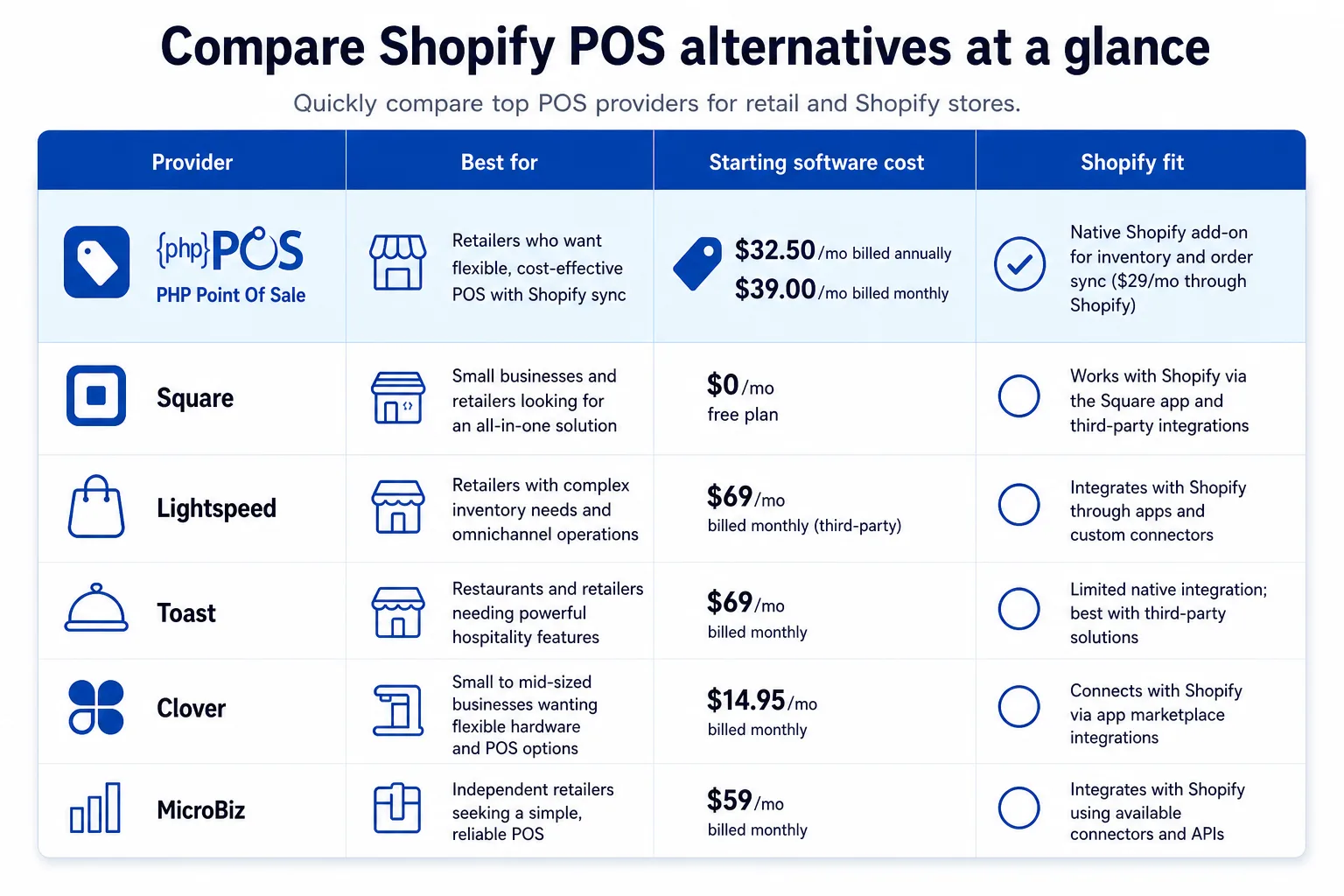
The top Shopify POS alternatives in 2026 include PHP Point of Sale, Square, Lightspeed Retail, Toast, Clover, MicroBiz, and Helcim. The right pick depends on whether you stay on Shopify for ecommerce, how many locations you run, and whether you need restaurant, retail, or hybrid workflows.
1. PHP Point of Sale
Best for: Retailers who want affordable, full-featured POS with optional Shopify sync while keeping their Shopify store.
PHP Point of Sale offers cloud hosting with unlimited registers on Standard, plus an on-prem enterprise license option for teams that want local control.
PHP POS cloud pricing (published on buy.php):
| Plan | Billed annually | Billed monthly |
|---|---|---|
| Standard | $54.00/mo per location | $59.00/mo per location |
| Pro | $79.00/mo per location | $84.00/mo per location |
Shopify fit: The Shopify integration syncs inventory and imports Shopify orders for centralized reporting (cloud only; $29.00/mo through Shopify with a 14-day trial). You can also connect WooCommerce, QuickBooks, and Square per product pages.
Why it beats Shopify POS for many SMBs: lower Standard software cost per location, flexible deployment, and retail-first reporting without replacing your ecommerce stack.
Start free trial | View features | Compare PHP POS vs Shopify
2. Square POS
Best for: Single-location shops that want fast setup and a permanent free software tier.
Square is the default recommendation in many comparison guides for simple retail and food businesses. Plans often start at $0 per month with paid tiers around $49 to $149 per month for advanced features (third-party 2026 breakdowns; Square pricing, not PHP POS). In-person processing is commonly quoted around 2.6% plus $0.10 in the US.
Shopify fit: Square Online is a separate product from Shopify. You can run Shopify online and Square in-store, but inventory unification requires integration work rather than native one-platform sync.
3. Lightspeed Retail
Best for: Established retailers with complex inventory, variants, and multi-location operations.
Lightspeed retail POS plans are often cited from about $89 to $289 per month depending on tier (third-party comparison sites, as of 2026). You get deeper stock control, purchasing workflows, and reporting than most entry POS tools.
Shopify fit: Lightspeed ecommerce is a separate product line. Omnichannel teams should map integration scope before committing.
4. Toast
Best for: Full-service restaurants, bars, and quick-service brands.
Toast is built for restaurant operations: kitchen display, course firing, server workflows, and hospitality-specific reporting. Pricing varies by product bundle; many operators use custom quotes at scale.
Shopify fit: Limited for typical Shopify-first retailers. Choose Toast when food service logic matters more than Shopify ecommerce depth.
5. Clover
Best for: Small brick-and-mortar businesses that want hardware bundles and straightforward checkout.
Clover combines POS software with Clover hardware and payment processing. Published entry plans are often in the teens to tens of dollars per month plus hardware, with higher tiers for multi-register stores (third-party 2026 comparisons).
Shopify fit: Ecommerce integration is more limited than Shopify-native POS. Best when in-store is the primary channel.
6. MicroBiz
Best for: Independent retailers that want desktop-style inventory depth without enterprise complexity.
MicroBiz appears frequently in Shopify POS alternative roundups for specialty retail, repairs, and multi-store inventory. It targets operators who outgrow basic cloud POS but do not need a full enterprise suite.
Shopify fit: Evaluate connector options for your SKU complexity and order flow before migration.
7. Helcim POS
Best for: Cost-conscious operators who want interchange-plus style processing with POS software included.
Helcim markets POS with processing-based pricing and volume discounts rather than heavy monthly software fees. Strong when payment cost matters more than ecommerce app depth.
Shopify fit: Works as in-store POS with integration planning; not a Shopify-native replacement.
How do Shopify POS alternatives compare at a glance?
Use this table for a quick read on software cost and Shopify ecommerce fit. Confirm current rates on each vendor site; processing fees, hardware, and add-ons change total cost of ownership.
| Provider | Best for | Starting software cost (2026) | Shopify ecommerce fit |
|---|---|---|---|
| PHP Point of Sale | Keep Shopify store, upgrade in-store POS | $54.00/mo (annual) / $59.00/mo (monthly) per location | Shopify add-on $29.00/mo (cloud) |
| Shopify POS | All-in-one Shopify stack | POS Lite with plan; POS Pro ~$89/mo per location (third-party cites) | Native |
| Square POS | Simple retail, fast launch | $0 tier available; paid tiers ~$49-$149/mo (Square) | Integration required |
| Lightspeed Retail | Complex inventory, multi-location | From ~$89/mo (third-party cites) | Separate ecommerce product |
| Toast | Restaurants and hospitality | Custom / tiered | Not typical for Shopify-first |
| Clover | Hardware-led SMB retail | Low entry plans + hardware | Limited native ecommerce |
| MicroBiz | Specialty retail inventory | Varies by deployment | Connector-dependent |
| Helcim POS | Processing-cost optimization | Software bundled with processing | Integration required |
For a deeper side-by-side, see PHP POS vs Shopify.
Can you keep Shopify online and upgrade in-store POS?
Yes. Many merchants want Shopify for the online catalog, SEO, and app ecosystem, but prefer a POS built for daily register work, purchase orders, and store-level reporting. PHP Point of Sale fits that split without forcing a platform migration.
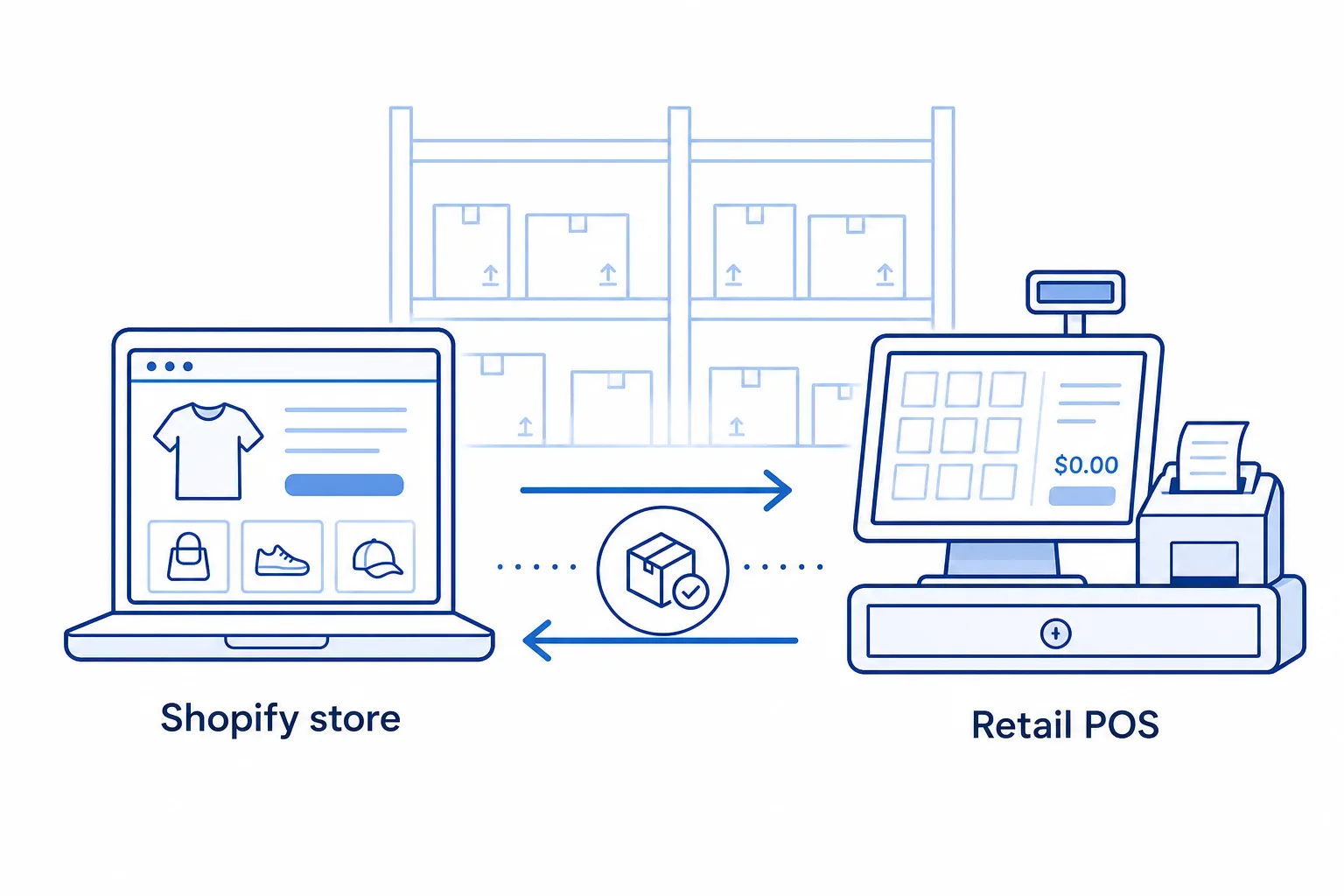
- Enter and manage inventory in POS, push updates to Shopify through the Shopify add-on ($29.00/mo, billed through Shopify).
- Import Shopify orders for unified reporting in POS.
- Run unlimited registers on Standard (per published plan details on buy.php).
- Add Pro features such as AI-assisted workflows and label design when you scale ($79.00/mo billed annually or $84.00/mo billed monthly per location).
If you are migrating off Shopify POS specifically, export product, customer, and tax data first, then run a parallel checkout week before you cut over registers.
Which business types benefit most from a Shopify POS alternative?
Different store types need different POS depth. Boutiques and multi-location retailers often prioritize inventory and per-location pricing; restaurants need kitchen and table workflows; online-first popups may tolerate lighter in-store tools.
| Business type | Best fit | Why |
|---|---|---|
| Boutique retail | PHP Point of Sale, Square | Tier pricing, fast checkout, Shopify sync option |
| Multi-location retail | Lightspeed, PHP Point of Sale | Inventory depth and per-location pricing control |
| Restaurants | Toast, Square | Table and kitchen workflows |
| Repair and specialty shops | MicroBiz, PHP Point of Sale | Serials, work orders, service tickets |
| Online-first with one popup | Shopify POS or Square | Lowest integration overhead |
| High SKU count | Lightspeed, PHP Point of Sale Pro | Variants, purchasing, reporting |
What do Shopify POS alternatives cost? (software only)
Software-only pricing helps you compare before adding processing and hardware. Use our POS cost calculator to model your full switch.
One location, basic retail
- Shopify POS Pro: often about $89 per month per location plus Shopify plan (third-party 2026 guides).
- PHP Point of Sale Standard: $54.00 per month per location billed annually, or $59.00 per month per location billed monthly (buy page).
- Square: $0 software tier possible; pay processing and optional Plus plan (Square paid tiers often $49-$149/mo, third-party cites).
Three locations, growing SKU catalog
- Shopify POS Pro at three locations can exceed $250 per month in software before processing (using $89 per location estimate).
- Three PHP Point of Sale Standard locations at monthly billing: $167.00 per month in software before processing ($59.00 for the first location + 2 x $54.00 for each additional one).
- Lightspeed: higher software cost, stronger enterprise inventory.
Always model card processing separately. At $50,000 or more in monthly card volume, interchange-plus providers can change the math.
How do you choose the right Shopify POS alternative?
Shortlist vendors by channel strategy first, then match industry features and true monthly cost including processing and hardware.
Ask five questions:
- Are we staying on Shopify for ecommerce?
- Do we need restaurant-specific features or general retail?
- How many locations and registers do we run today?
- Is on-prem or cloud hosting required for compliance or speed?
- What is our true monthly cost including processing and hardware?
If you answered yes to staying on Shopify and want retail-first POS at published flat pricing, shortlist PHP Point of Sale first. If you are restaurant-only, evaluate Toast before general retail tools.
FAQ
What is the best alternative to Shopify POS?
PHP Point of Sale is the best Shopify POS alternative for retailers who want to keep Shopify for ecommerce and run a dedicated in-store POS. You get unlimited registers per location from $54.00 per month on annual billing, plus a $29.00/mo Shopify sync add-on.
Can I keep Shopify online and use a different POS in-store?
Yes. Many stores use Shopify for ecommerce and a separate POS for physical checkout. PHP Point of Sale offers a Shopify add-on that syncs inventory and imports orders on cloud plans.
How much does PHP POS cost compared to Shopify POS?
PHP POS Cloud Standard starts at $54.00 per location per month on annual billing. Pro is $79.00. Shopify POS Pro is commonly cited around $89 per location per month plus your Shopify plan. Registers stay unlimited on advertised PHP POS plans. See pricing.
Does PHP POS work with WooCommerce too?
Yes. PHP POS lists WooCommerce integration alongside Shopify, so you can keep either storefront and run retail checkout in one POS.
What is the best Shopify POS alternative for restaurants?
Toast is the usual pick for full-service restaurants. Square is common for lighter food operations. PHP Point of Sale fits counter-service retail more than full dining-room workflows.
Bottom line
The best alternative to Shopify POS is not always a new ecommerce platform. It is the POS that matches your inventory, budget, and channel strategy. For retailers keeping Shopify online while upgrading checkout, reporting, and cost control, PHP Point of Sale is the strongest starting point in 2026 at $54.00/mo billed annually or $59.00/mo billed monthly per location.