Credit Card Processing Fees in 2026: How to Read Your Statement and Cut Your Effective Rate

Ask a retailer what their credit card processing costs and you will usually hear the rate a salesperson quoted them. Ask what they actually paid last month divided by what they actually ran, and the room goes quiet. That second number is your effective rate, and it is the only one worth managing.
The gap between the two is rarely small, because a quoted rate describes one clean transaction on a good day while your effective rate describes all of them — including the keyed sales, the downgrades and the monthly line items nobody mentioned in the meeting. A store that believes it is paying around 2.6% can easily be at 3.1%. On $50,000 a month, that half point is $3,000 a year, sitting in a PDF nobody opens.
This guide is the statement audit we walk merchants through. You will calculate your effective rate from a single statement, learn which of the four fee layers you can genuinely move and which you cannot, find the fees worth arguing about, and see where the 2026 Visa and Mastercard settlement fits in. Bring last month's statement and a calculator.
What is your effective rate, and how do you calculate it?
Your effective rate is every dollar your processor charged you in a month divided by every dollar you ran in card sales, expressed as a percentage. It is the only figure that captures interchange, network fees, markup, monthly charges and mistakes in one number, which is exactly why quotes are never expressed this way.
The formula is deliberately unforgiving:
Effective rate = total fees charged ÷ total card volume × 100
Two rules make it honest. Count every fee, including the ones billed separately or debited mid-month rather than netted out of a deposit — PCI program fees and annual fees are the usual escapees. And use card volume, not total sales, or cash and check tenders will flatter the result.
Prorate anything that is not monthly. An annual or quarterly fee dumped entirely into one statement produces an anomalously high effective rate; skipping that month omits the cost entirely. Spread those charges over their billing period (divide an annual fee by 12, a quarterly fee by 3) before you divide, or run the formula across a full year of fees and volume. The baseline you hand competing offers has to include every recurring dollar you actually pay.
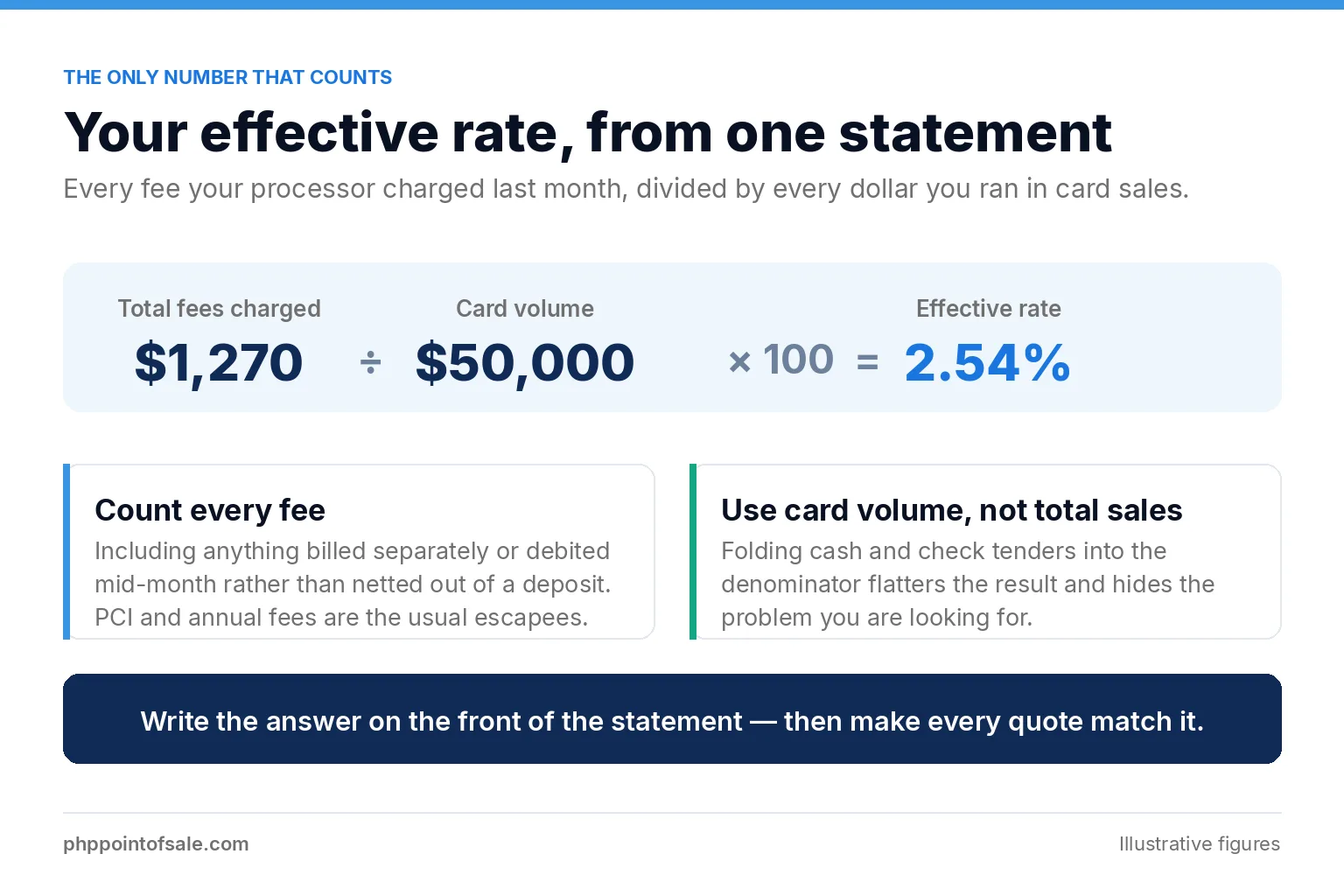
Run it once and write the answer on the front of the statement. You now have a baseline that any competing offer has to beat on the same terms, which quietly ends the game of comparing a quoted rate against an all-in cost.
What are the four layers inside every card fee?
Every card fee is a stack of four layers: interchange paid to the bank that issued the card, assessments paid to the card network, your processor's markup, and fixed monthly charges. Two of those layers are wholesale costs identical for every merchant. Two are the negotiation.
Interchange goes to the cardholder's issuing bank and is the largest layer by a wide margin — typically somewhere between 1.5% and 2.5% of a credit transaction depending on the card and how it was accepted. Visa and Mastercard set and publish these schedules; Visa's are on its regulations and fees page. No processor discounts interchange, because no processor keeps it.
Debit is the exception worth knowing. Under the Federal Reserve's Regulation II, banks with $10 billion or more in assets cannot take more than 21 cents plus 0.05% of the transaction, plus a one-cent fraud-prevention adjustment. Regulated debit on a $40 sale costs about 24 cents. A premium rewards credit card on the same sale costs closer to 94 cents.
Assessments are the networks' own cut, roughly 0.13% to 0.15% of volume plus small per-transaction network fees. Also wholesale, also not negotiable, and also not where your leverage is.
Processor markup is what your provider keeps. On an interchange-plus plan it is stated plainly as a percentage and a per-transaction amount. On a flat or tiered plan it is folded into a single number you cannot see.
Fixed monthly charges are the statement fees, PCI program fees, gateway fees, monthly minimums and annual fees. Individually trivial, collectively a rounding error that shows up in your bank account every month.
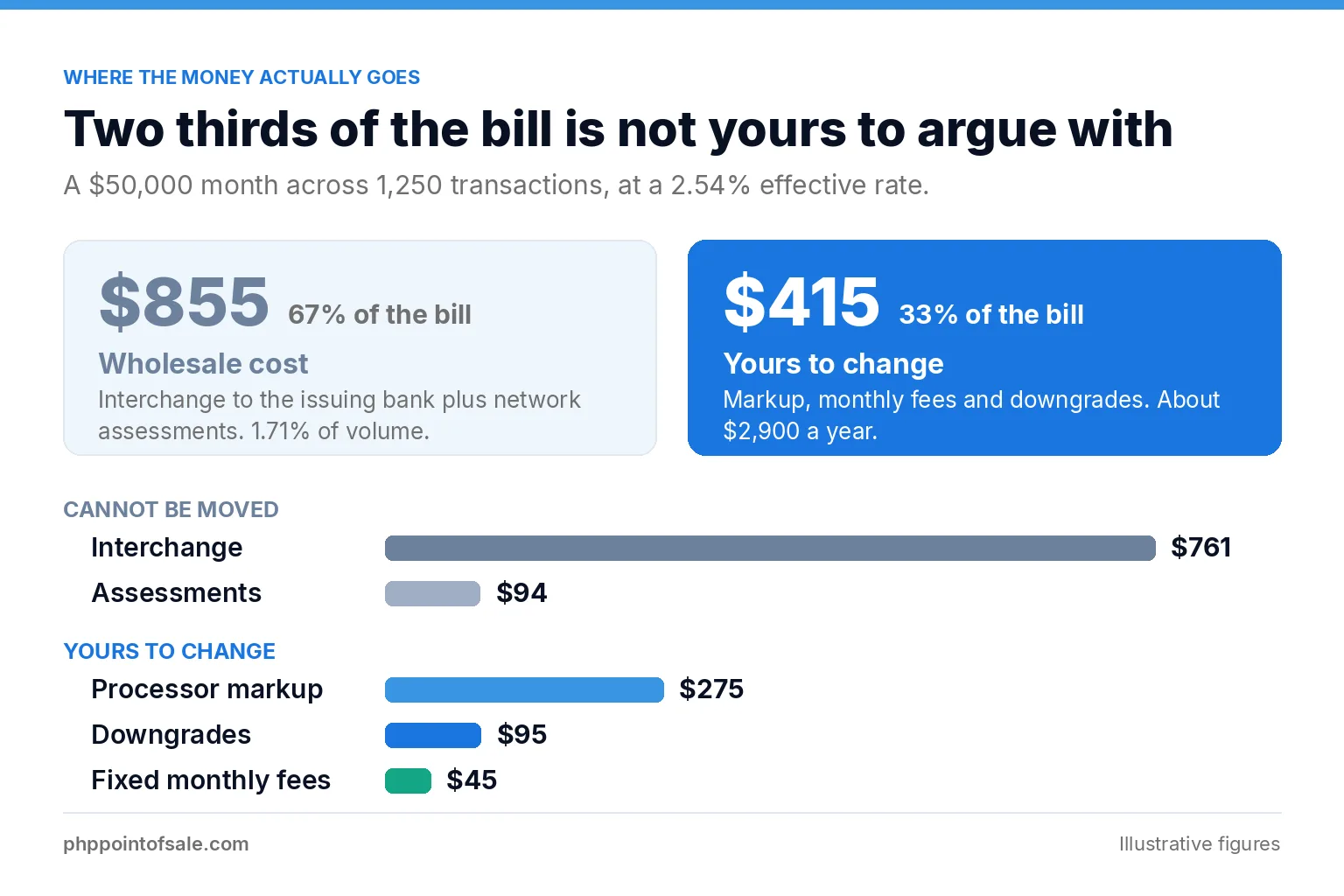
Here is that stack on a real-shaped month: $50,000 in card volume across 1,250 transactions, a $40 average ticket, and a mix of regulated debit, standard credit and premium rewards credit. Downgrades get their own line because, while they are really just interchange you paid more of than you had to, they behave like a fee you can remove.
| Fee layer | Cost | Share of bill | Who sets it | Can you move it? |
|---|---|---|---|---|
| Interchange | $761 | 60% | Card-issuing banks | No — but you can avoid downgrades |
| Assessments and network fees | $94 | 7% | Visa, Mastercard, Discover | No |
| Processor markup | $275 | 22% | Your processor | Yes — this is the negotiation |
| Fixed monthly fees | $45 | 4% | Your processor | Yes — often removable |
| Downgrades | $95 | 7% | Your own workflow | Yes — fix at the counter |
| Total | $1,270 | 100% |
That is an effective rate of 2.54%. The wholesale floor — interchange plus assessments — is $855, or 1.71%. Every dollar above that floor, $415 of it, is in play.
Tighten the markup to 0.15% plus a nickel, strip the removable monthly fees, and fix most of the downgrades, and the controllable portion falls to roughly $173. The effective rate lands near 2.06%: about $2,900 a year on a $50,000-a-month store, with no change to what you sell or what you charge for it.
Which pricing model are you on, and does it matter?
Your pricing model determines how much of that stack you are allowed to see, which in practice determines how much of it you can argue with. Most retailers are on flat-rate or tiered pricing without having chosen either.
| Model | How it works | Best for | The catch |
|---|---|---|---|
| Flat rate | One published rate for every card, whatever the card | Low volume, unpredictable months, wanting zero admin | You pay the same for a 24¢ debit card as for a 94¢ rewards card. Debit-heavy stores subsidize the processor. |
| Interchange-plus | Interchange and assessments at cost, plus a stated markup | Most established retailers, especially above ~$15k/month | Statements are long. Verify the pass-through lines are not padded. |
| Tiered | Transactions sorted into “qualified”, “mid” and “non-qualified” buckets | Nobody, honestly | Your processor decides which bucket each sale lands in. The definitions are theirs to change. |
| Subscription | Interchange at cost plus a monthly fee and a small per-transaction charge | High volume with a large average ticket | The monthly fee only pays for itself above a certain volume. Do the arithmetic first. |
Flat rate is not a trap; it is a trade. You are buying predictability, and for a store running $6,000 a month it is usually the right purchase. The trade stops making sense as volume climbs, because the processor's share grows in lockstep with your sales while its cost to serve you does not.
Tiered pricing is different. It is the one model where the party sending the invoice also decides which category each transaction belongs to. If your statement uses the words qualified and non-qualified, that is the first thing to change, ahead of any conversation about rates.
Why does your card mix cost you more than your rate?
Because a rate is applied to a mix, and the mix does the heavy lifting. Two stores on identical pricing can land 60 basis points apart purely on what their customers hand across the counter and how big the average ticket is.
Two effects compound:
- Card type. Regulated debit is capped by federal rule. Premium rewards credit is not, and someone has to fund those airline miles. That someone is the merchant who accepted the card.
- Average ticket. Every layer includes per-transaction pennies. On a $40 sale, 10 cents is 25 basis points. On a $4 sale, the same dime is 250 of them. Small tickets are where fixed pennies quietly become your largest line item.
This is why a universal “good rate” benchmark does not survive contact with a real statement. A grocery-adjacent store with $85 tickets and heavy PIN debit ought to be near 2%. A gift shop with $12 tickets and customers paying on travel rewards cards can be at 2.7% and still be well priced. Judge your number against your own mix, not against a figure in a blog post — including this one.
Two things follow. Make sure debit cards are not being forced through credit/signature routes when a cheaper debit network is available — and the reverse: on small tickets or cards from issuers exempt from Regulation II, the PIN route is not always cheaper than signature debit, so compare the network options your terminal actually offers rather than assuming “debit” wins. That is a POS and terminal configuration question. And if your average ticket is genuinely tiny, weight your comparison toward the per-transaction cents rather than the percentage, because that is where your money is actually going. For software and register-count arithmetic separate from processing, use the true POS cost calculator; for the fee layers themselves, stay with your statement and the effective-rate math above.
What is a downgrade, and why is it costing you silently?
A downgrade is a transaction that was eligible for a cheaper interchange category and got billed at a more expensive one because it was missing data the network wanted. It is the single most common avoidable cost on a retail statement, and it never appears under a heading called “downgrades”.
The usual triggers are mundane and entirely fixable at the counter:
- Keying a card by hand instead of dipping, tapping or swiping it.
- Not batching out at close. Settle within 24 hours; a batch left open overnight can reprice the whole day.
- Missing address verification on phone and invoice payments, where a ZIP code alone often saves the category.
- Corporate and purchasing cards without Level 2 data. If you sell to businesses, passing a tax amount and an invoice number can move those transactions to a materially cheaper tier.
- Voice-authorized or force-posted sales entered after the fact.
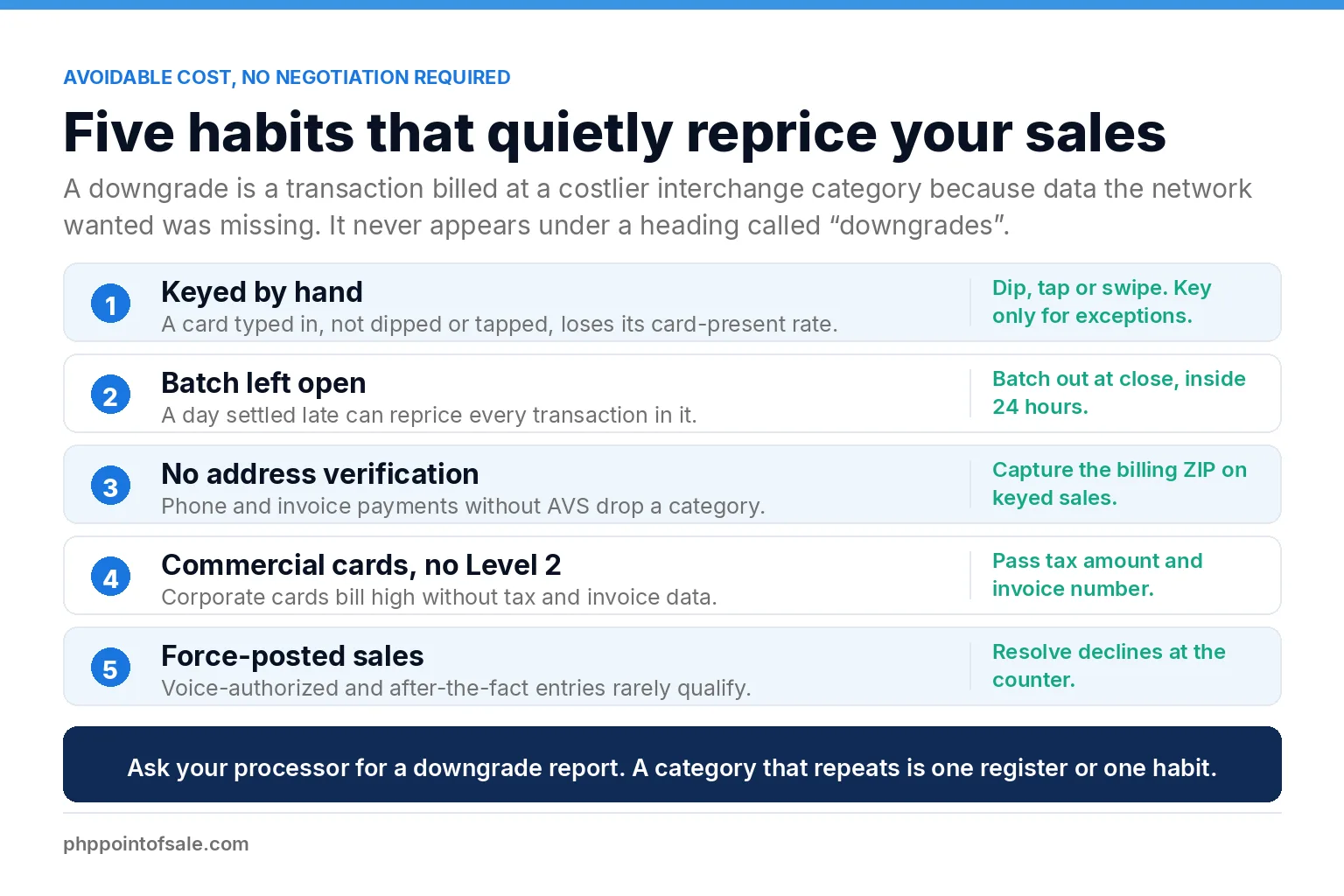
Downgrades are worth chasing precisely because they are not a negotiation. Nobody has to agree to anything. Ask your processor for a downgrade report — an interchange-plus statement usually already itemizes the categories — and look for the same category appearing over and over. That pattern is almost always one register, one employee or one workflow, and it is generally a training fix rather than a technology one.
Should you surcharge or run a cash discount?
Both shift some card cost to the customer who chose the card, and both are heavily rule-bound. A surcharge adds a fee to card payments. A cash discount posts card pricing as your standard price and takes an amount off for cash. They are treated differently by state law, which is the main reason the distinction matters.
The card network requirements are specific. Visa's own merchant surcharging Q&A sets out the shape of it:
- Credit cards only. Debit and prepaid cards can never be surcharged, in any state.
- The surcharge is capped at the lower of your merchant discount rate for that card or 3%.
- Disclosure at the point of entry, at the point of sale and on every receipt.
- Written notice to your acquirer 30 days before you switch it on.
State law sits on top of those rules and is where merchants get caught. Visa's own document notes that its understanding as of February 2024 was that Connecticut, Maine, Massachusetts, Oklahoma and Puerto Rico prohibited surcharging, while Colorado, Minnesota, New Jersey and New York imposed specific requirements — and Visa is careful to say that is not legal advice and may be out of date. Several state statutes have also been challenged in federal court, so the practical position in a given state can differ from the statute on the books. If you operate in more than one state, this is a question for a lawyer, not a processor's sales deck.
Before any of that, model the outcome on paper. The cash discount calculator shows discount dollars and processing-fee savings from your volume, rate and discount percentage; the margin calculator shows how a price or cost change moves unit margin. Neither tool models customers switching tender or walking away, so bake those assumptions in yourself — recovering 2.5% is a poor trade if it costs you a percent of transactions and some goodwill at the counter.
If you do go ahead, the mechanics should live in the terminal rather than in a cashier's head. Surcharging is built into the Valor and Dejavoo devices on our payments page — the VP100 and VL110 countertop and mobile units and the Dejavoo P1 — so the fee, the disclosure and the receipt line are handled consistently on every sale. PHP Point of Sale can also apply the fee in software, whatever terminal you use: Store Config → Payment Types carries a markup/markdown percentage per payment type, a fee label, and tier exclusions, and the fee is added to the sale as its own line so it shows on the receipt. Manual surcharging is a compliance incident waiting for a slow Saturday.
What does the 2026 Visa and Mastercard settlement change?
On June 9, 2026, a federal judge in Brooklyn granted preliminary approval to a revised $38 billion settlement between Visa, Mastercard and roughly 12 million US merchants, ending — provisionally — a case that had been running since 2005. It is genuinely significant, and it will not change your next statement.
What the terms would do, as reported by Reuters and Payments Dive:
- Cut credit interchange rates by 10 basis points for five years.
- Cap standard consumer card rates at 1.25% for eight years.
- Relax the “honor all cards” rule, letting merchants decline categories of higher-cost premium and commercial credit cards rather than accepting every card carrying a brand.
- Widen merchants' latitude to surcharge and to discount by card category, so you can steer customers toward cheaper tenders.
The timing is the part to be sober about. This was preliminary approval. A class notice period and a fairness hearing follow, the National Retail Federation and others are still opposed, and appeals are expected. Analysts quoted at the time put final implementation anywhere from 2027 to 2029.
So treat it as a reason to keep your contract flexible rather than a reason to wait. A long-term deal with an early termination fee is a worse idea in 2026 than it was in 2024, because the ground under acceptance costs is going to move. The 0.83% of volume sitting in your markup, monthly fees and downgrades is available now, is larger than 10 basis points, and does not require a judge.
How does your POS affect what you pay?
Your POS decides which processors you can use, how debit is routed across available networks, whether surcharging is enforced consistently, and whether switching processors means switching systems. A POS that locks you to one processor has quietly removed your only real negotiating position.
Two arrangements are worth insisting on. Bring your own processor: PHP Point of Sale connects supported existing processors through Valor, Dejavoo or Datacap, and adds no processing fee of its own for doing so, so a better quote elsewhere does not mean a migration. Or take platform processing — PHP POS Payments typically averages about 2.6% as the percentage component, plus $0.05–$0.10 per transaction and a $10–$40 monthly platform fee, with no contract, no cancellation fee and no monthly minimum. PHP POS Payments is available to United States merchants; outside the US you connect a supported processor instead. We deliberately do not bill the statement, deposit and PCI fees that pad the bottom of most invoices.
That 2.6% is the typical average rate on the pricing card, not an all-in effective rate. The per-transaction cents and monthly platform fee still sit on top of it, and on low-ticket volume those extras move the effective number more than the percentage does — the same arithmetic this guide uses on your current statement. Your own figure depends on card mix, average ticket and volume, which is why the quote process starts with your statements rather than a rate card. If we review them and cannot beat your current cost, we will give you $100.
If a processing conversation is really a POS conversation, the features page and pricing are the place to start, and switching from Square to a cheaper POS covers the migration mechanics. Multi-location operators should read the multi-location guide first, since per-location billing changes the arithmetic considerably.
The 30-minute statement audit
Do this once a year and after any processor change. It is thirty minutes and it is the highest-return half hour in your back office.
- Pull one full statement. A typical month, not your best or your worst.
- Total every fee, including anything billed separately from the deposits. Prorate annual and quarterly charges over their billing period so one month is not overstated and another is not understated.
- Divide by card volume to get your effective rate. Write it on the front page.
- Identify your pricing model. If you see “qualified” and “non-qualified”, you are on tiered pricing and should move.
- Find your markup. On interchange-plus it is a line item. On flat-rate it is unknowable — which is itself the finding.
- List every fixed monthly fee and ask, per line, what it buys. PCI program fees, statement fees, gateway fees and monthly minimums are the usual candidates for removal.
- Check the pass-through lines against the networks' published schedules. A padded “assessment” line on a plan sold as interchange-plus is not interchange-plus.
- Ask for a downgrade report and look for a repeating category. One register, one habit, one fix.
- Compare debit routes in your POS and terminal settings: PIN versus signature, and against credit routing, using your ticket size and issuer mix — do not assume one path is always cheaper.
- Compare on effective rate only. When a competing quote arrives, hand over the same statement and ask for total monthly cost, not a rate.
- Read the contract terms before signing anything: length, early termination fee, rate-increase clauses, equipment lease. A lease on a $275 terminal is the most expensive way to buy a $275 terminal.
- Re-run the number next quarter to confirm the change actually landed on your invoice.
Step 11 deserves emphasis. Most merchants who feel trapped are not trapped by a rate; they are trapped by a 48-month contract with a four-figure exit fee, usually signed alongside an equipment lease. Rates can be renegotiated at any time. Contracts cannot.
FAQ
What is a good effective rate for a retail store?
It depends on your card mix and average ticket, which is why a single benchmark misleads. A store with large tickets and heavy PIN debit should be near 2%. A store with $12 tickets and customers on premium rewards cards can be legitimately above 2.6%. Compare your number to your own wholesale floor — interchange plus assessments — rather than to someone else's store.
Can I negotiate interchange fees?
No. Interchange is set by the card networks and paid to the issuing bank, so no processor can discount it. What you can do is stop paying more interchange than you owe, by avoiding downgrades: dip or tap instead of keying, batch within 24 hours, capture AVS on keyed sales, and pass Level 2 data on commercial cards.
Is interchange-plus always cheaper than flat rate?
Usually above roughly $15,000 a month, but not always. Interchange-plus adds monthly fees that a flat-rate account may not have, and a padded pass-through can wipe out the benefit. Price both models against the same statement and compare total monthly cost.
What is a PCI compliance fee, and do I have to pay it?
It is a charge some processors add for a compliance program and portal. PCI compliance itself is mandatory; that particular fee is not universal. A non-compliance fee is avoidable by completing the full validation your acquirer assigns — usually an annual SAQ, and for some merchant types also quarterly ASV scans or other evidence — not the questionnaire alone. Both the program fee and the non-compliance fee are worth questioning line by line.
Will the 2026 swipe fee settlement lower my rates?
Eventually and modestly, if it survives. Preliminary approval came in June 2026, with a 10 basis point cut and a 1.25% cap on standard consumer credit among the terms, but final approval and the likely appeals mean statement changes are not expected before 2027. Do not defer a cost review waiting for it.
Is surcharging legal in my state?
It depends on the state, and the picture changes. Network rules permit credit-card surcharging up to the lower of your cost of acceptance or 3%, never on debit or prepaid, with disclosure at entry, at the point of sale and on the receipt. Several states prohibit or restrict it, and some of those statutes have been challenged in court. Confirm with your own counsel before switching it on.
Do I have to change POS systems to change processors?
You should not have to, and that is worth checking before you sign anything. PHP Point of Sale supports connecting existing processors through Valor, Dejavoo or Datacap without adding a processing fee, so the processor decision stays separate from the software decision.
Bottom line
Two thirds of your processing bill is wholesale cost you cannot change, and that is fine — it is the same for your competitors. The other third is markup, monthly fees and downgrades, and it is worth about half a point of volume to most retailers who go looking for it.
Start with one statement and one division. Then talk to a processor about total monthly cost rather than a rate, and keep the contract short enough that the next conversation is still yours to have. If you would like a second pair of eyes, request a payments quote, book a demo, or get in touch — bring the statement.