PHP Point of Sale Reviews (2026): What Retailers Say

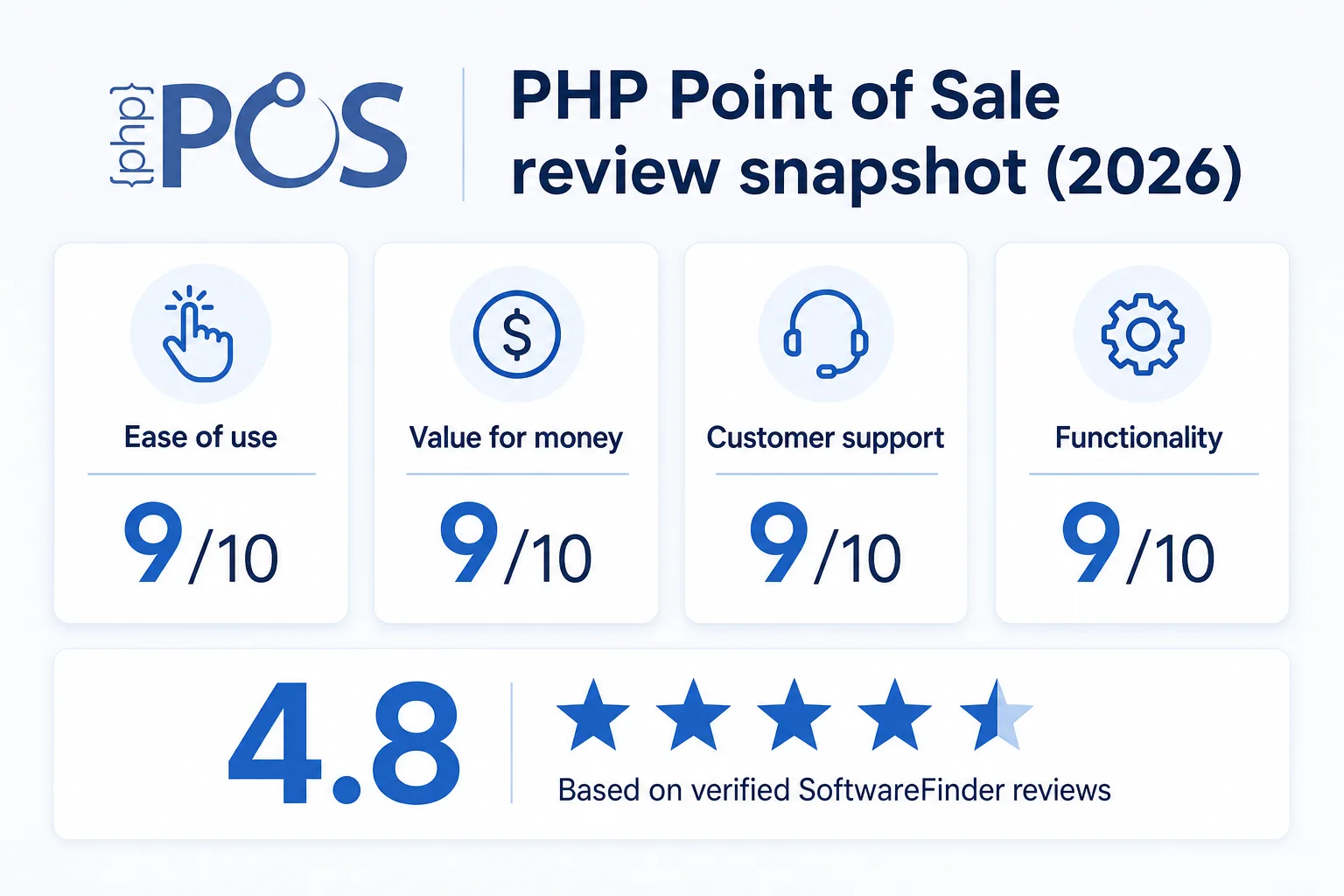
PHP Point of Sale reviews in 2026 are generally positive for small and mid-size retailers who care about inventory control, responsive support, and per-location pricing instead of per-register add-ons. Verified listings show a 4.8 out of 5 average on SoftwareFinder, with high marks for ease of use, value, and customer support. Merchants also praise unlimited registers per location, flexible hardware, and processor choice.
If you are comparing POS systems, reviews only matter when they match your store type. This guide summarizes third-party ratings, on-site customer stories, honest pros and cons, and who should trial PHP Point of Sale before switching from Clover, Lightspeed, Square, or a discontinued system like QuickBooks POS.
What do PHP Point of Sale reviews say overall?
PHP Point of Sale reviews say the system is easy for staff to learn, strong on inventory and reporting, and backed by responsive support without long hold queues. Verified SoftwareFinder reviews average 4.8 out of 5 across six published ratings, with category scores near 9 out of 10 for ease of use, value for money, customer support, and functionality.
Reviewers repeatedly mention one license per physical location even when multiple registers run at once, which matters when you compare PHP POS to platforms that charge per device. Cloud hosting is available from $54.00 per location per month on annual Standard billing, with a 14-day free trial and no credit card required. Prices shown are for the United States; see the pricing page for your country.
What do merchants praise most in PHP POS reviews?
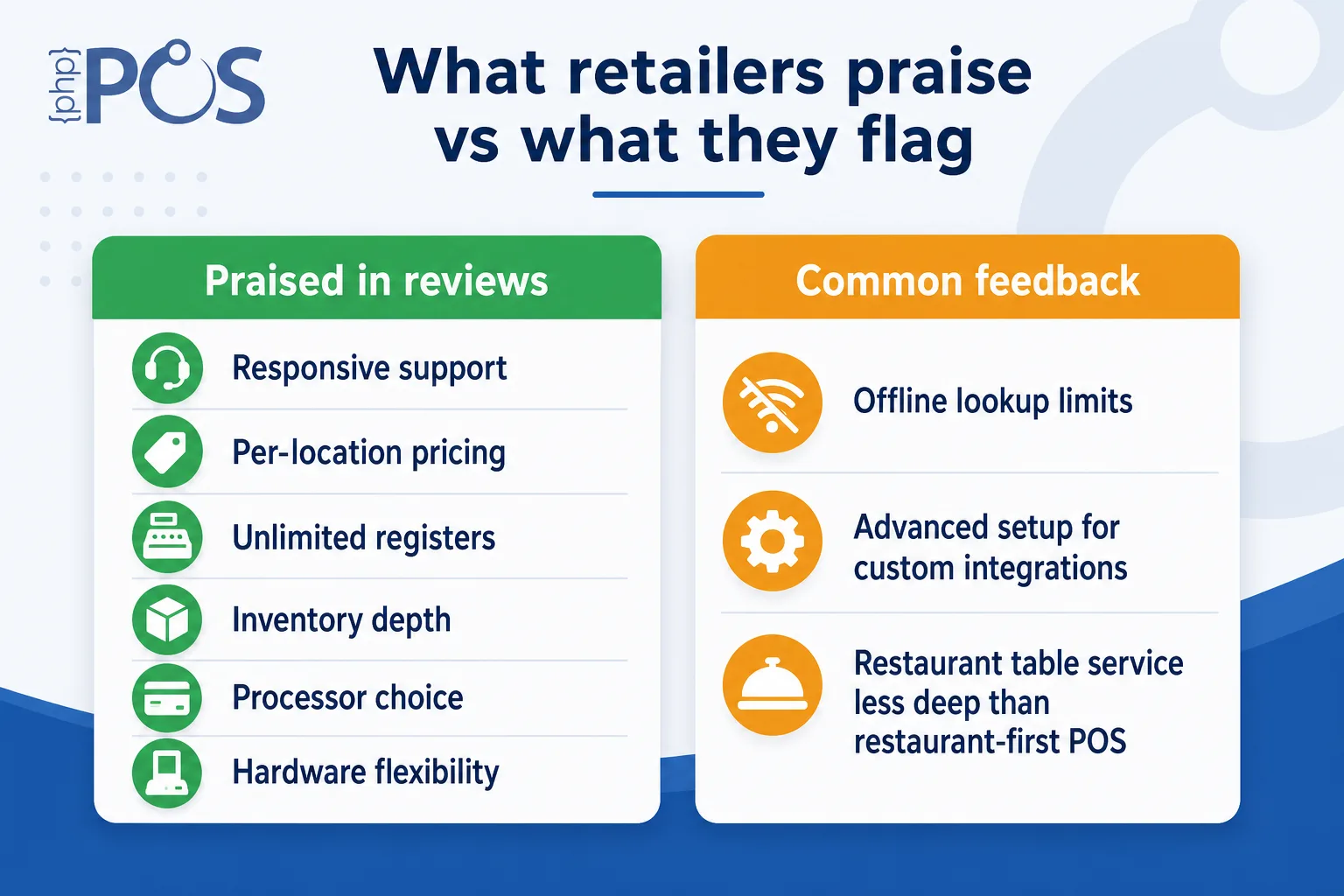
Merchants praise PHP POS most for customer support, inventory depth, pricing transparency, and hardware flexibility. Long-term users on SoftwareFinder describe bugs fixed in hours or days, processor choice that lets them shop rates, and the ability to run on iPads, Android tablets, or PCs for redundancy.
On phppointofsale.com, published customer stories echo the same themes:
- RGV Homebrew Supply (Rudolph Mayer, owner) cites ease, fair price, remote access, and support that stayed strong as the business grew.
- Pinelane Nursery (Angie and Kurt Hughes, owners) moved from QuickBooks POS for lower cost and more customization, with hands-on help on labels and reports.
- Imagination Station Science and History Museum (Brian Grawburg, IT and bookkeeping) chose PHP POS for flexible reporting on Linux and staff who preferred it over QuickBooks POS after nearly two years of daily use.
Those first-party stories align with third-party praise for operational fit, not just star ratings.
What are the most common PHP Point of Sale complaints?
The most common PHP Point of Sale complaints in public reviews involve offline mode limits, deeper custom integrations that need technical comfort, and restaurant table workflows that are not as deep as restaurant-first platforms like Toast. Fair reviewers still rate the product highly because workarounds exist and support responds quickly.
Specific feedback from verified SoftwareFinder reviews includes:
- Offline mode: barcode lookup and saved cards can be limited until you are back online (noted by a long-term retail reviewer).
- Integrations: some advanced setups need extra technical know-how (education-sector reviewer).
- Restaurant features: table management is not as integrated as dedicated restaurant POS (software reviewer).
- Receipt and register close reports: a few users want clearer end-of-day detail or tighter customer-facing display integration.
PHP POS has addressed many gaps over time with cloud hosting, PHPPOS Genie AI, receipt and label designers (all three on the Pro plan), and expanded payment options. Treat complaints as evaluation checkpoints, not automatic disqualifiers.
How does PHP Point of Sale pricing look in reviews?
PHP Point of Sale pricing in reviews is described as strong value because you pay per location, not per register or employee. Cloud Standard starts at $54.00 per location per month on annual billing on the pricing page. Pro adds PHPPOS Genie, the Custom Label Designer, the Custom Receipt Designer, and PrintNode integration at $79.00 per location per month on annual billing.
Cloud customers get automatic backups, upgrades, and hosted security as part of the subscription. Optional Shopify inventory sync is billed separately at $29.00 per month through Shopify.
When you read a review that calls PHP POS "cheap," check whether the writer counted registers, employees, processing, and ecommerce add-ons. Use the True POS Cost Calculator to compare your real stack against Square, Clover, or Lightspeed quotes.
Who is PHP Point of Sale best for according to reviews?
According to reviews, PHP Point of Sale is best for inventory-led retailers, multi-register locations that want one license per store, and operators migrating from discontinued or overpriced POS systems. Pharmacy retail, wholesale, homebrew, nursery, museum gift shop, and specialty retail appear repeatedly in public feedback.
PHP POS is a weaker fit when you run full-service dining with complex table service as your core workflow, or when you want a zero-IT, fully managed ecosystem with no configuration at all. In those cases, reviewers often pair PHP POS with a restaurant platform or choose Square for the simplest first location.
Match reviews to your vertical:
- Product retail with variants and POs: strong fit (features)
- QuickBooks POS refugee: strong fit (QuickBooks POS alternative)
- Clover reseller contract frustration: compare PHP POS vs Clover
- Payments-first micro store: consider PHP POS vs Square
How does PHP POS compare to Clover, Square, and Lightspeed in reviews?
In aggregated comparisons, PHP POS often scores higher on value and support satisfaction among retailers who need inventory depth, while Square wins on fastest setup, Clover on hardware ecosystem, and Lightspeed on complex matrix catalogs at a higher monthly price. No single review site captures every vertical, so weigh sources against your store type.
Useful reference points:
- SoftwareFinder lists PHP Point of Sale at 4.8 out of 5 with strong support and value subscores (PHP Point of Sale reviews on SoftwareFinder).
- Clover and Square reviews often praise simplicity but flag processing bundles or per-device fees (see our Clover alternative guide).
- Lightspeed reviews praise inventory for specialty retail but cite higher starting software tiers (see our Lightspeed alternative guide).
PHP POS differentiators that show up across reviews: unlimited registers and employees per location, offline selling on cloud builds, API access for custom workflows, and flexible payment processing including Square, Stripe, and PHP POS Payments.
Should you trust PHP Point of Sale reviews or run your own trial?
You should treat PHP Point of Sale reviews as a shortlist filter, then run your own 14-day trial on real items, real staff, and your actual card reader before you cancel an existing contract. Reviews cannot test your barcode mix, tax rules, or ecommerce sync the way a parallel day on your floor can.
A practical validation plan:
- Import a sample of items and customers from CSV (features import tools)
- Run refunds, discounts, and end-of-day close with two cashiers
- Test offline mode if your internet is unreliable
- Confirm your processor setup on PHP POS Payments or your existing compatible gateway
- Book a demo if you need migration help from QuickBooks POS or Clover
Reviews plus a live trial beat any single star rating.
FAQ
Is PHP Point of Sale legit and safe to use?
PHP Point of Sale is a long-running retail POS used by thousands of merchants, with cloud hosting, automatic backups on hosted plans, and direct support channels. Legitimacy in reviews comes from verified customer accounts on third-party sites plus published customer stories on phppointofsale.com.
What is PHP Point of Sale rated in 2026?
On SoftwareFinder, PHP Point of Sale shows a 4.8 out of 5 average across six verified reviews, with category scores near 9 out of 10 for ease of use, value, support, and functionality. Ratings vary by platform and review volume.
What are the main pros of PHP Point of Sale?
Reviewers praise responsive support, per-location licensing with unlimited registers, inventory and transfer tools, processor flexibility, hardware choice across tablets and PCs, and strong value relative to per-device competitors.
What are the main cons of PHP Point of Sale?
Common cons include offline mode limitations for lookup and saved cards, technical comfort needed for advanced custom integrations, and restaurant table service that is not as deep as restaurant-only POS platforms.
How much does PHP Point of Sale cost?
Cloud Standard starts at $54.00 per location per month on annual billing. Pro is $79.00 per location per month on annual billing. Enterprise custom plans start at $499 per month. A 14-day cloud trial requires no credit card.
Is PHP Point of Sale good for small retail stores?
Yes. Reviews from small retail, nursery, homebrew, museum, and pharmacy businesses highlight ease of use, inventory control, and support. Stores that only need basic payments with minimal inventory may also consider Square for a simpler entry point.
Bottom line
PHP Point of Sale reviews in 2026 portray a retail-focused POS that wins on support, inventory, and per-location value more than on restaurant table management or zero-config simplicity. That profile fits growing retailers who have outgrown payment-first apps and bundled reseller contracts.
Read the pricing page, explore features, and start a free trial. If you want help mapping your migration, contact PHP POS or schedule a demo before your current POS renewal.